
The Repair Team in Fujairah You've Never Worked With — How Do You Actually Vet Them in Time?
Muhammed Irfan • Sep 15, 2026
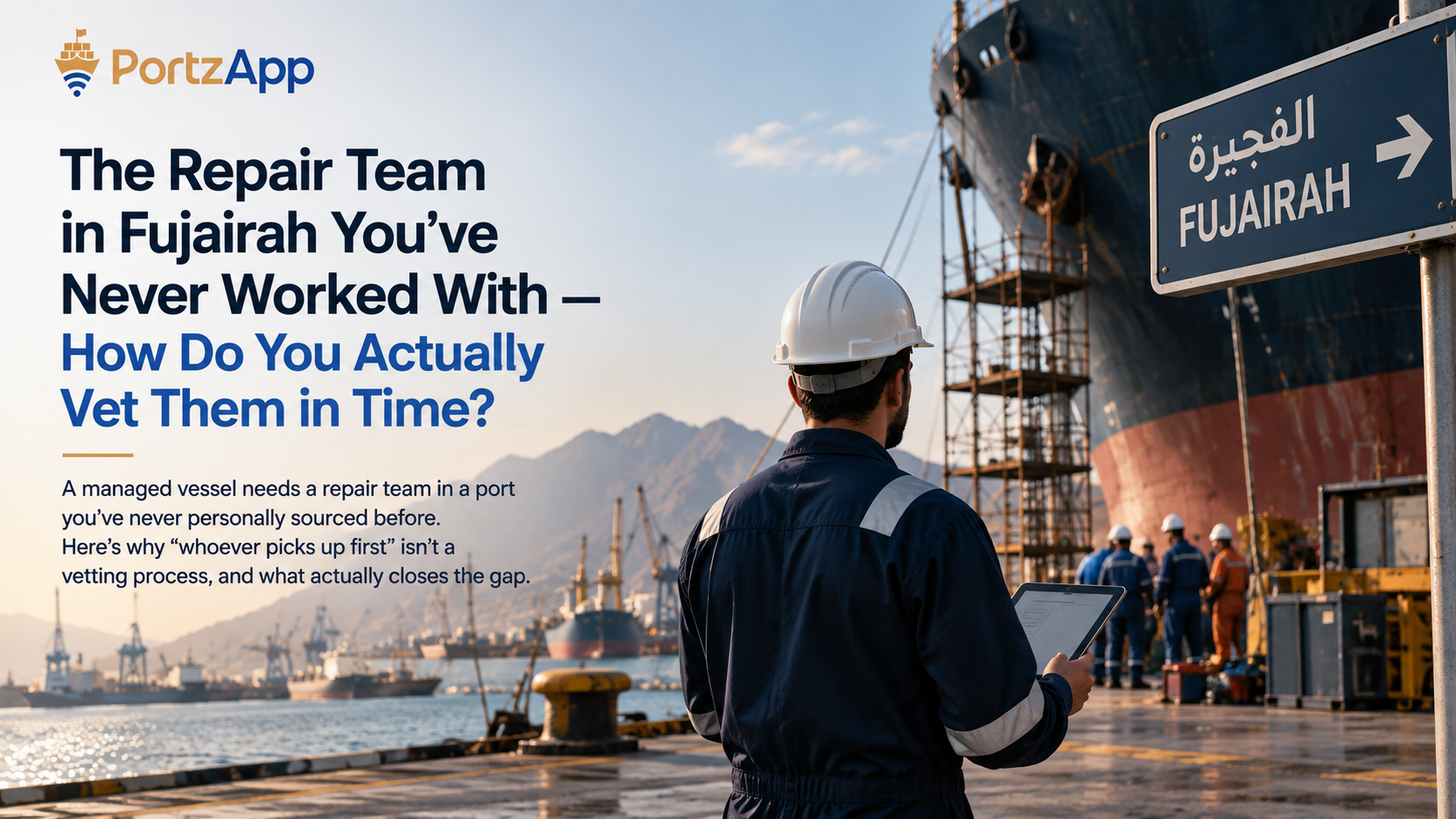
Your vessel needs a repair team in Fujairah, provisions in Rotterdam, a surveyor in Santos. Three ports, three owners, and you've personally worked with a provider in none of them. Each time, you're starting from scratch — calling contacts, emailing agents, asking around — and the quality of the job ends up depending on whoever picks up first.
The problem, specifically
A managed fleet doesn't call at the ports you know. It calls at whatever ports the cargo commitments and charter routes dictate — which means the vessels under your management are constantly showing up somewhere you don't have a trusted contact. You ask around, send emails, wait for replies, and hope whoever responds is actually reliable. There's no way to verify credentials or compare options quickly, so speed and diligence end up trading off against each other. And once a provider does quote, there's a second decision waiting: do you hold payment until the job proves itself, or take the cheaper option and hope the engine still runs a week later? Every sourcing decision becomes a trade-off between cost, trust, and time, with no structured way to verify who you're actually working with.
Why this isn't a one-off — it's structural
This is exactly where personal-network sourcing hits its ceiling. Referrals, manual outreach, and individual trust judgments work fine within a familiar circle — a manager running two or three ports with providers they've used for a decade gets fast, trusted coordination for free. But a managed fleet, by definition, doesn't stay inside that circle. Coverage has to expand faster than any one person's memory of who's reliable where. Manual search and word of mouth don't scale with the fleet; they scale with how many ports one person has personally worked.
What it actually costs
Sourcing this way is slow by design — every new port means rebuilding trust from zero, with no record of who else has vetted this provider before you. PortzApp's own benchmark across the platform: RFQs that used to take up to 48 hours to get a quote back now typically clear in around 30 minutes, with port costs coming down roughly 14% once sourcing runs through verified, comparable quotes instead of one-off outreach. That's a platform-wide figure, not one measured specifically for managed fleets — but it's a direct read on exactly this problem: how long it takes to go from "we need a provider in a port we don't know" to a comparable, verifiable answer.
How PortzApp closes the gap
The fix isn't a better contacts list. It's a verified network that travels with the fleet instead of living in one person's inbox. Every provider on PortzApp goes through KYC verification — business registration, credentials, operational capability — before they can list as a verified provider, so a profile in Fujairah carries the same baseline trust as one in a port you've worked for years. Search by port and service type instead of asking around, and the RFQ goes to every registered provider that matches, not just the two or three people who happen to be in your contacts. Existing relationships aren't replaced — bring your trusted providers onto the platform and keep using them — but for the ports where you don't have one yet, the marketplace covers the gap instead of leaving you to cold-call.
Personal networks vs. a verified marketplace
Personal networks and referrals aren't wrong, they're just local. They cover finding providers in ports you already know, and they hit a wall the moment coverage needs to grow past what one operator can personally vouch for. A verified marketplace flips the default: search by port and service instead of manual outreach, KYC-verified profiles instead of "references and experience," a global network instead of a personal contact list. For a managed fleet touching new ports on a rolling basis, that difference compounds every time the vessel moves somewhere new.
See it on your next unfamiliar port call
You don't need to migrate the whole fleet to test this. Run the next port call at a port you haven't personally sourced before through PortzApp, and compare how long it takes to get a verifiable, comparable quote. The Standard plan is free — there's no cost to see whether the search-from-scratch problem actually closes on your very first unfamiliar port.
CTA: See how verified sourcing works for a managed fleet → https://portzapp.com/solutions/ship-managers